
Living with ADHD: Real Truths & Insights
Discover the unvarnished truth about living with ADHD, including time blindness, executive dysfunction, and relationship challenges. Gain practical insights from real experiences without the fluff.
3/3/202611 min read
A Field Guide to Surviving Modern Life When Your Brain Operates Like a Caffeinated Squirrel
Let's cut through the inspirational bullshit and talk about what ADHD actually looks like in real life. Not the sanitized version you see in awareness campaigns with smiling people holding colorful brain models, but the messy, chaotic, sometimes hilarious reality of trying to function as an adult when your brain has the attention span of a goldfish and the impulse control of a toddler in a candy store.
If you're here, you probably already know that ADHD isn't just "trouble paying attention in school." It's a full-contact sport with daily life, affecting everything from your ability to remember where you put your keys (spoiler: they're in the refrigerator again) to maintaining relationships without accidentally offending everyone you care about.
So buckle up, buttercup. We're about to take a deep dive into the beautiful disaster that is ADHD in the wild, complete with real examples, practical solutions, and enough dark humor to make the medicine go down easier.
The ADHD Daily Life Experience: A Comedy of Errors
Picture this: You wake up with the best intentions. Today is going to be THE day. You're going to be productive, organized, and maybe even remember to eat lunch at a reasonable hour. You sit down at your desk, open your laptop, and immediately notice seventeen browser tabs from last night's research spiral about whether penguins have knees.
Three hours later, you've reorganized your entire digital photo library by color and emotional resonance, learned more about Antarctic wildlife than any reasonable person should know, and completely forgotten about the work presentation that's due in two hours.
This isn't a character flaw. This isn't laziness. This is ADHD in its natural habitat.
Reality Check: ADHD affects approximately 4-5% of adults, but it impacts 100% of their daily decisions, from what to wear (decision paralysis) to what to eat (forgot to grocery shop again) to how to prioritize tasks (everything feels equally urgent and impossible).
Workplace Chaos: When Your Brain Doesn't Play Well with Corporate Culture
Let's talk about the workplace, shall we? That magical land where neurotypical people seem to effortlessly navigate meetings, deadlines, and office politics while you're over here trying to figure out why your brain decided that organizing your desk drawer is more important than the quarterly report that's due tomorrow.
The Open Office Nightmare
Open offices were clearly designed by someone who has never experienced sensory overload. For ADHD brains, they're basically torture chambers disguised as "collaborative spaces." Every conversation, keyboard click, and coffee machine gurgle becomes a potential distraction that derails your train of thought.
Real Example: Sarah, a marketing manager with ADHD, describes her daily struggle: "I'll be deep in writing a campaign proposal when someone three cubicles over starts talking about their weekend plans. Suddenly, I'm mentally planning my own weekend, wondering if I should try that new hiking trail, researching hiking boots online, and reading reviews for two hours. Meanwhile, my proposal sits there with one paragraph written."
The Meeting Minefield
Meetings are where ADHD symptoms go to party. You walk in with good intentions, but within five minutes, you're either hyperfocusing on the pattern in the conference room carpet or mentally redesigning the entire office layout while your colleagues discuss quarterly projections.
The Classic ADHD Meeting Experience:
First 5 minutes: Trying to look engaged while your brain catalogs every sound in the room
Minutes 6-15: Hyperfocusing on taking the most detailed notes ever written
Minutes 16-30: Realizing you've been drawing elaborate doodles and missed the last ten minutes of discussion
Final 15 minutes: Panic-listening while trying to figure out what you're supposed to do next
Workplace Accommodations That Actually Work
Here's the thing about workplace accommodations: most managers think "just try harder" is a reasonable solution. It's not. Here are accommodations that actually make a difference.
1. Noise-Canceling Headphones: Your New Best Friend
Invest in good noise-canceling headphones. Not the cheap ones that make you look like you're working at an airport—the real deal that creates a bubble of focus around your brain. Many employers will provide these as a reasonable accommodation.
2. Written Instructions and Follow-Up Emails
Ask for meeting summaries and written instructions. Your brain might miss verbal directions, but having them in writing gives you something to reference when you inevitably forget what was discussed.
3. Flexible Work Arrangements
If possible, negotiate for some remote work days or flexible hours. Sometimes the difference between a productive day and a disaster is being able to work when your brain is actually functioning.
4. Task Prioritization Support
Work with your manager to clearly define priorities. ADHD brains struggle with the "everything is urgent" trap, so having explicit guidance about what matters most can be a game-changer.
Procrastination: The ADHD Specialty Sport
Let's address the elephant in the room: procrastination. For people with ADHD, procrastination isn't just putting things off—it's a complex dance between executive dysfunction, perfectionism, and the brain's desperate search for dopamine.
The Procrastination Cycle of Doom
Here's how it usually goes:
Look at important task
Feel overwhelmed by the scope/complexity/boringness
Brain says "Nope!" and finds literally anything else to do
Feel guilty about avoiding the task
Task becomes more urgent and scary
Panic sets in
Finally complete task in a frenzied last-minute sprint
Swear you'll never do this again
Repeat cycle with next task
Real-Life Procrastination Examples
The Tax Return Saga: Meet James, who spent four years avoiding filing a simple tax return. Not because it was complicated—he had all the documents and it would have taken maybe two hours. But every time he thought about it, his brain would find something else to do. He reorganized his entire apartment, learned to make sourdough bread, and became an expert on 1970s music trivia. The task felt so overwhelming that his brain treated it like a threat to be avoided at all costs.
The Email Black Hole: Lisa has 14,000 unread emails in her inbox. She knows most of them are junk, but the thought of sorting through them feels impossible. So she just... doesn't. She's created elaborate workarounds, including multiple email addresses and a complex system of filters, all to avoid dealing with the original problem.
Breaking the Procrastination Cycle
1. The Two-Minute Rule
If something takes less than two minutes, do it immediately. Reply to that text. File that document. Put the dish in the dishwasher. This prevents the accumulation of tiny tasks that eventually become an overwhelming mountain.
2. Task Breakdown to Ridiculous Levels
Instead of "file taxes," break it down to:
Find tax documents folder
Open tax software
Enter name and address
Take a break and celebrate
Yes, it feels insulting to your intelligence. Yes, it works.
3. The Pomodoro Technique (ADHD Edition)
Traditional Pomodoro suggests 25-minute work blocks. For ADHD brains, try 10-15 minutes. You can do anything for 10 minutes, even taxes.
Forgetfulness: When Your Brain Is a Sieve
ADHD forgetfulness isn't just "oops, I forgot." It's a systematic failure of working memory that affects everything from where you put your keys to whether you remembered to eat lunch to that important conversation you had yesterday that your brain has apparently deleted.
The Relationship Impact
Forgetfulness can be devastating to relationships. Your partner tells you about their important presentation, and you genuinely care and want to be supportive. But three days later, when they're stressed about it, you have no memory of the conversation. To them, it looks like you don't care. To you, it feels like your brain is betraying you.
Real Example: Mark's wife asked him to pick up milk on his way home from work. He genuinely intended to do it, even made a mental note. But by the time he got to the store, his brain had moved on to seventeen other things. He came home with everything except milk, leading to a fight about whether he actually listens to her. The truth? His brain just doesn't hold onto information the way neurotypical brains do.
Memory Coping Strategies
1. External Memory Systems
Your brain is not a reliable storage device. Outsource everything to external systems:
Phone reminders for everything (and I mean everything)
Calendar alerts for appointments AND preparation time
Sticky notes in strategic locations
Voice memos for capturing thoughts on the go
2. The "Capture Everything" Approach
Carry a notebook or use your phone to immediately capture any important information. Don't trust your brain to remember it later—it won't.
3. Location-Based Reminders
Use your phone's location services to remind you of things when you're in specific places. "Remind me to buy milk when I'm at the grocery store" is more effective than trying to remember on your own.
Impulsivity: When Your Brain Skips the "Think First" Step


ADHD impulsivity isn't just about buying things you don't need (though that happens too). It's about saying things without thinking, making decisions without considering consequences, and generally living life with the emotional regulation of a caffeinated teenager.
The Social Consequences
Impulsivity can wreak havoc on relationships and social situations. You interrupt people mid-sentence because your brain has something VERY IMPORTANT to say right now. You make jokes at inappropriate times. You share personal information that probably should have stayed private.
Real Example: During a work meeting, Jennifer's boss was explaining a new policy that she thought was unnecessarily complicated. Without thinking, she blurted out, "This seems like a solution in search of a problem." While she wasn't wrong, the timing and delivery were... less than ideal. Her impulsivity had once again gotten her in trouble, despite her good intentions.
The Financial Impact
ADHD impulsivity and money management go together like fire and gasoline. You see something interesting, your brain gets excited, and suddenly you've bought a $200 gadget that you'll use twice and then forget about.
The Amazon Cart Phenomenon: Many people with ADHD have mastered the art of filling online shopping carts and then abandoning them. It satisfies the impulsive urge to buy without actually spending money. It's like window shopping for the digital age.
Managing Impulsivity
1. The 24-Hour Rule
For any non-essential purchase over $50, wait 24 hours before buying. Often, the impulse will pass, and you'll realize you don't actually need that thing.
2. Pause and Breathe
When you feel the urge to say something or make a quick decision, try to pause and take three deep breaths. Give your prefrontal cortex a chance to catch up with your impulses.
3. Accountability Partners
Having someone who can gently call you out on impulsive decisions can be incredibly helpful. This isn't about judgment—it's about having an external perspective when your internal one is compromised.
Organization: The Eternal Struggle
Organization for ADHD brains isn't about having a perfectly color-coded filing system (though if that works for you, more power to you). It's about creating systems that work with your brain's chaos, not against it [9].
The "Organized Chaos" Approach
Some people with ADHD thrive in what looks like chaos to others but makes perfect sense to them. The key is finding systems that match how your brain actually works, not how you think it should work.
Real Example: David's desk looks like a tornado hit it, but he knows exactly where everything is. His filing system is based on "recent," "somewhat recent," and "ancient," which works perfectly for his brain. When he tried to implement a traditional filing system, he couldn't find anything and productivity plummeted.
Organization Systems That Actually Work
1. Visual Organization
Use clear containers so you can see what's inside
Keep frequently used items visible and accessible
Use color-coding for different categories
Label everything (seriously, everything)
2. The "One-Touch" Rule
When you pick something up, try to deal with it immediately rather than moving it to another pile. This prevents the accumulation of "I'll deal with this later" items.
3. Digital Organization Tools
Use apps like Todoist or Any.do for task management
Set up automatic bill pay to avoid late fees
Use cloud storage with good search functionality
Create templates for recurring tasks
Calendar and Reminder Systems: Your External Brain
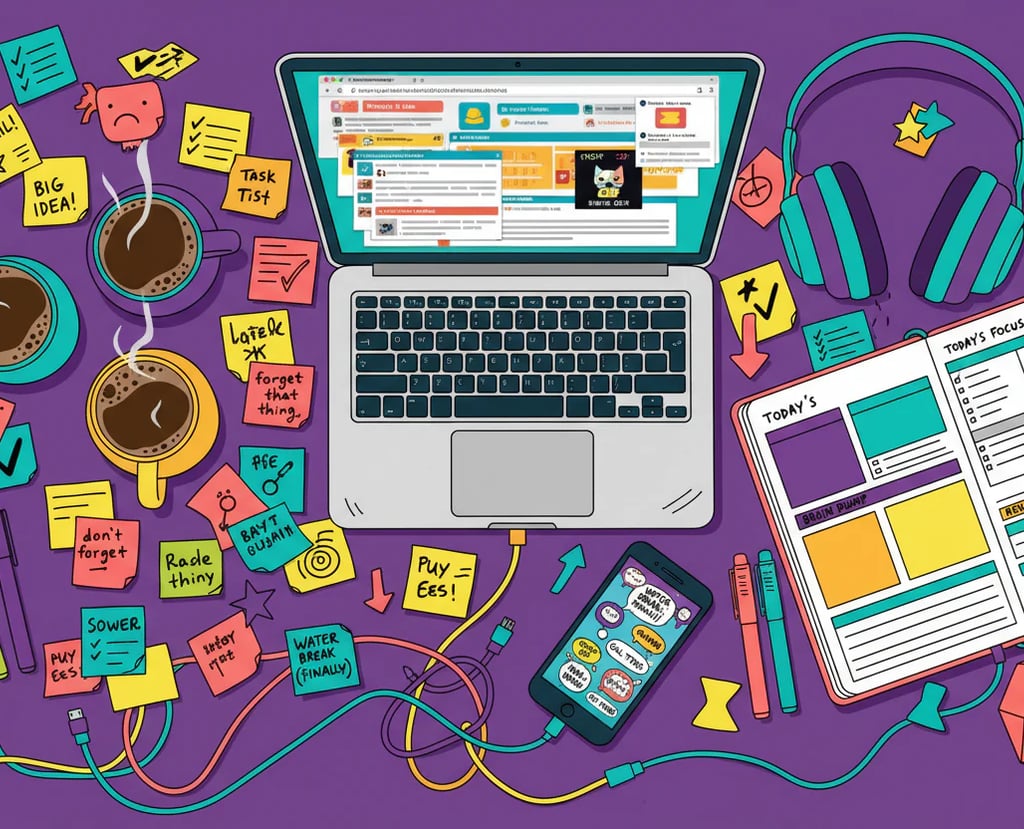

Your calendar isn't just for appointments—it's your external brain that remembers all the things your actual brain will forget.
Calendar Strategies That Work
1. Time-Blocking
Don't just schedule meetings—schedule everything. Block time for focused work, email processing, even lunch. This helps prevent the "where did my day go?" phenomenon.
2. Buffer Time
Add 15-30 minutes of buffer time between appointments. ADHD brains consistently underestimate how long things take, so build in extra time.
3. Multiple Reminder Systems
Set reminders for the appointment
Set reminders to start getting ready
Set reminders to leave
Set location-based reminders
The Power of Accountability Partners
Accountability partners aren't about having someone nag you—they're about having external structure when your internal structure fails.
What Makes a Good Accountability Partner
Understanding: They get that ADHD is a real neurological difference, not a character flaw
Consistency: They check in regularly without being overwhelming
Non-judgmental: They focus on problem-solving, not blame
Flexible: They understand that some days will be better than others
Accountability Strategies
Weekly check-ins to review goals and challenges
Body doubling sessions for difficult tasks
Shared calendars for important deadlines
Text reminders for time-sensitive tasks
Technology Tools That Don't Suck
Let's be honest—most productivity apps are designed by neurotypical people for neurotypical brains. But there are some tools that actually work for ADHD minds.
Focus and Distraction Management
1. Noise-Canceling Solutions
Sony WH-1000XM4 or Bose QuietComfort: Industry-standard noise cancellation
Brain.fm: Background music designed to enhance focus
Noisli: Customizable background noise generator
2. Website and App Blockers
Freedom: Blocks distracting sites across all devices
Cold Turkey: The nuclear option for serious distraction blocking
Forest: Gamifies focus time by growing virtual trees
Organization and Planning
1. Task Management
Todoist: Natural language processing makes adding tasks easy
Any.do: Simple, visual task management
Notion: All-in-one workspace (can be overwhelming but powerful)
2. Calendar and Scheduling
Google Calendar: Multiple calendars for different life areas
Calendly: Automated scheduling to reduce back-and-forth
TimeTree: Shared calendars for families and teams
The Emotional Toll: When ADHD Affects Mental Health
Living with ADHD isn't just about practical challenges—it's emotionally exhausting. The constant feeling of being "behind," the shame of forgetting important things, the frustration of knowing what you need to do but being unable to do it.
The Masking Phenomenon
Many adults with ADHD become experts at "masking"—hiding their symptoms to appear more neurotypical. This takes enormous mental energy and often leads to burnout.
Real Example: Rachel spent years perfecting the art of looking organized and on top of things at work. She'd arrive early to prepare for meetings, over-prepare for presentations, and work late to compensate for time lost to distractions. From the outside, she looked like a high-performer. Inside, she was exhausted and constantly anxious about being "found out."
Building Self-Compassion
The most important skill for managing ADHD might be learning to be kind to yourself. Your brain works differently, and that's not a moral failing.
Self-Compassion Strategies
Reframe "Failures" as Data: Instead of "I'm terrible at time management," try "My brain needs more external structure for time awareness"
Celebrate Small Wins: Remembered to eat lunch? That's a victory worth acknowledging
Practice the "Good Friend" Test: Would you talk to a good friend the way you talk to yourself? If not, adjust your internal dialogue
Building Your ADHD Management Ecosystem
Managing ADHD isn't about finding one perfect solution—it's about building an ecosystem of strategies, tools, and support systems that work together.
The Four Pillars of ADHD Management
1. External Structure
Calendars, reminders, and organizational systems
Environmental modifications (lighting, noise control, workspace setup)
Routines and habits that provide predictability
2. Internal Awareness
Understanding your energy patterns and working with them
Recognizing your triggers and early warning signs
Developing emotional regulation skills
3. Support Systems
Accountability partners and body doubling
Professional support (therapy, coaching, medical care)
ADHD-friendly communities and resources
4. Self-Compassion
Accepting that some days will be harder than others
Celebrating progress over perfection
Treating yourself with the same kindness you'd show a friend
The Bottom Line: You're Not Broken
Here's what I want you to remember: ADHD isn't a character flaw or a lack of willpower. It's a neurological difference that affects how you process information, manage attention, and regulate emotions. The world wasn't designed for ADHD brains, but that doesn't mean you can't thrive in it.
The strategies in this guide aren't about becoming neurotypical—they're about building a life that works with your brain, not against it. Some days you'll nail it, and some days you'll forget to wear matching socks and accidentally put your phone in the refrigerator. Both are valid ADHD experiences.
The goal isn't perfection; it's progress. And sometimes progress looks like remembering to eat lunch or finding your keys on the first try. Celebrate the small wins, because they add up to big changes over time.
Remember: you're not too much, you're not not enough, and you're definitely not alone in this beautiful, chaotic, caffeinated journey we call ADHD life.
P.S. - If you made it to the end of this article without getting distracted, congratulations! You've just accomplished something that would have been impossible for me to do before I learned these strategies. There's hope for all of us.