

You know that feeling when you sit down at 9:00 AM, ready to “crush it,” and your brain is just… gone? Imagine a dial-up modem sound playing on repeat in your skull. You look at your perfectly color-coded calendar screaming “Write Client Strategy Now” — and you’re staring at a Wikipedia page about the history of the stapler.
If you’re a freelancer with an ADHD-wired brain, the traditional calendar is basically a recurring invitation to feel like a failure. It assumes Tuesday at 10:00 AM will have the same mental capacity as Thursday at 2:00 PM. Spoiler: it never does.
The fix isn’t more discipline. It isn’t a better planner. It’s a fundamentally different approach: energy-based planning for ADHD freelancers. Stop managing your time. Start managing your battery.
The Real Problem
Why Time Management Is the Ultimate Gaslighter
Time is constant. Your energy is a chaotic, beautiful mess. Traditional time management assumes that if you have 40 hours in a week, you have 40 hours of “work juice.” For neurodivergent folks, energy isn’t a straight line — it’s a rollercoaster. Some days you’re feral in the best way: crushing tasks, replying to emails, practically vibrating with focus. Other days, you are a sentient potato.
When you force high-octane tasks into low-energy brain days, two things happen: you do the task poorly and slowly, then burn yourself out so thoroughly you lose the next three days to a productive hangover.
Traditional calendars are built around the idea that your brain is a reliable employee clocking in for the same shift every day. Not accurate. For many ADHD brains, attention, activation, and energy are state-dependent — not schedule-dependent. Monday at 10:00 AM might be “launch an offer, write a sales page, reorganize your backend” energy. Tuesday at 10:00 AM might be “I opened my laptop and now I’m staring into the void like it personally wronged me” energy.
There’s also the executive function piece. Calendar systems ask you to do a mountain of hidden labor before the actual work even starts: estimate how long tasks take, predict your future focus, sequence tasks logically, switch gears on command, and remember what Past You meant when you wrote “work on project.” That’s already a lot. Now add client work, invoices, a bad night of sleep, and the fact that your brain just decided it wants to learn candle-making at 1:13 PM.
CHADD point to the same consistent finding: the challenge for ADHD brains isn’t just “bad planning.” It’s that time perception, organization-in-time, and energy regulation are genuinely harder — and standard planning tools simply don’t account for that. A rigid calendar can become one more place where you collect evidence against yourself instead of support for yourself.
And then there’s the emotional weight. A calendar doesn’t just hold appointments — it holds expectations. When you miss a block that said “Write newsletter,” it can feel weirdly moral. Like you broke a promise. Like you failed at a simple adult task. That’s why energy-based planning for ADHD freelancers isn’t about doing more. It’s about doing the right things when you actually have the capacity to do them.
Your Brain, Explained
The Science of the “Spiky” Focus Profile
If you’ve ever felt lazy because you can’t focus on a simple task but then spent six hours perfectly designing a logo without blinking — congratulations. You’ve experienced the spiky focus profile. According to ADD.org, people with ADHD don’t necessarily have a deficit of attention. They have a dysregulation of it. We are interest-driven and energy-dependent.
This means a rigid calendar is effectively a list of things you might potentially fail at today. When you stop trying to manage time and start managing your battery, you stop fighting your own biology. There’s growing conversation in the ADHD productivity space about the need for systems that account for social scaffolding, variable activation, and state-based functioning — rather than assuming solo consistency all day long. If your system only works when you’re already focused, calm, and regulated, it’s not really a system. It’s a fantasy.
Energy-based planning for ADHD freelancers is the practical alternative: a workflow that bends to match your actual state instead of snapping the moment you have a rough morning.
The Core Framework
The Energy Battery: Four Tiers That Actually Match Reality
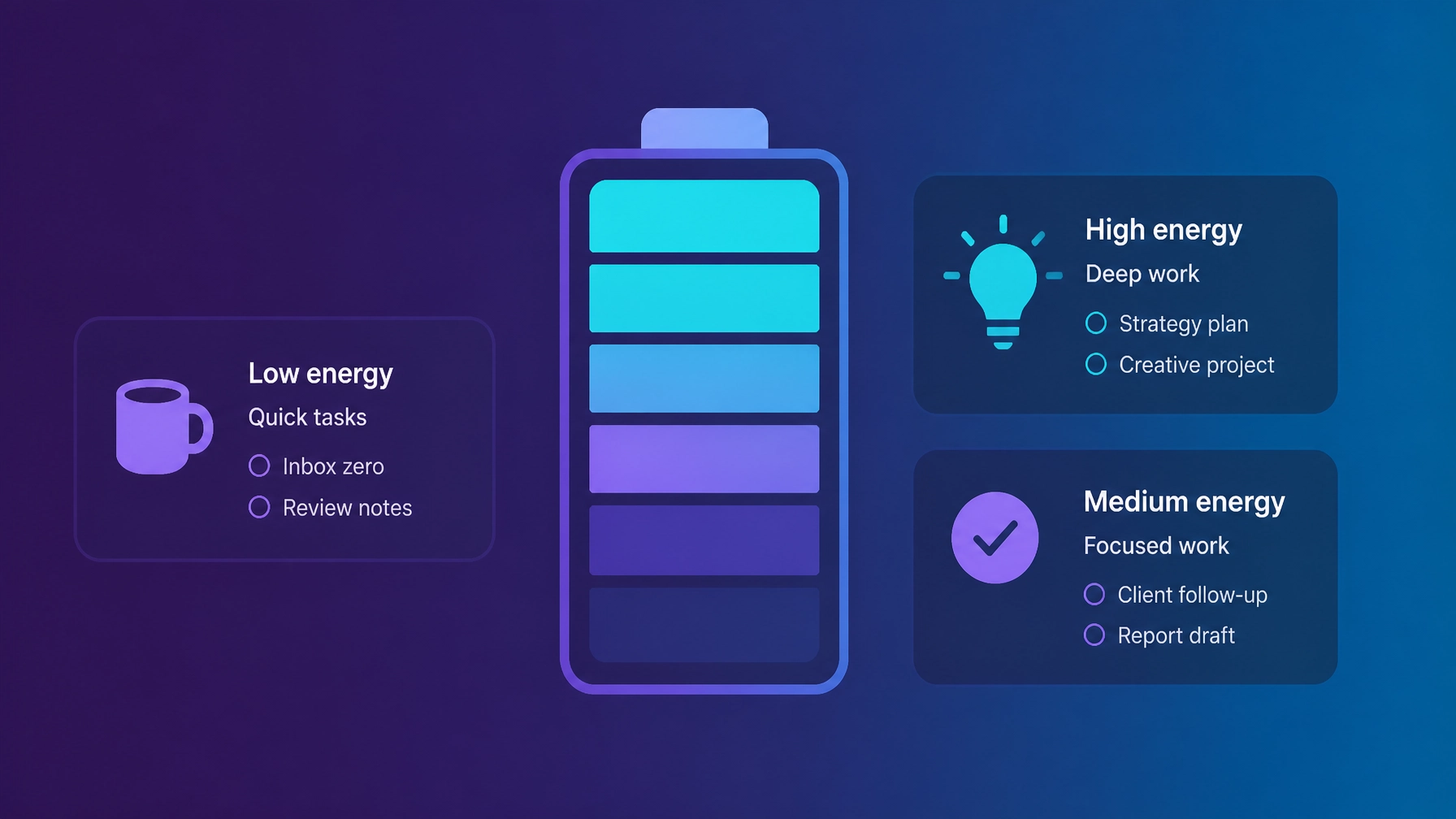
Instead of treating all tasks like they cost the same amount of brainpower, treat your energy like a battery. Some work is expensive. Some is moderate. Some is basically all you can manage before noon on a weird Tuesday. That distinction matters enormously when you’re building a sustainable week.
- Writing a sales page or pitch
- Client strategy and planning sessions
- Building or launching a new offer
- Solving complex technical problems
- Outlining content from scratch
- Making big business decisions
- Editing a draft you already wrote
- Client calls and check-ins
- Updating a Notion page or dashboard
- Repurposing existing content
- Light design work from an existing plan
- Sending follow-ups you already know how to write
- Clearing inbox clutter
- Sending invoices and tracking payments
- Organizing files and renaming documents
- Checking analytics
- Scheduling content that’s already done
- Updating your CRM
- Checking only the most urgent messages
- Moving due dates and clearing small blockers
- Brain-dumping loose thoughts into a doc
- Capturing ideas in your phone
- One five-minute admin task, maximum
- Resting on purpose — yes, this counts
Zombie Mode is not laziness. It’s not an excuse. It’s what happens when the battery is so depleted that even “easy” tasks feel like someone replaced your brain with soup. Most people keep trying to force high-energy output from a dead battery and then act shocked when the whole week unravels. Build Zombie Mode into your system before you need it — because you will need it.
Step 1
Map Your Internal Battery First
Before you can do energy-based planning for ADHD freelancers, you have to know what your energy actually looks like. Stop looking at your watch and start looking at your patterns.
For the next three to five days, keep receipts on your brain. Every hour or two, ask yourself: On a scale of 1–10, where is my focus right now? Then note the time and what kind of task felt doable. That’s the whole audit. You are not submitting this to a panel.
Do this for a few workdays. You’re looking for patterns: Do you think better before people can reach you? Do meetings kill the next two hours? Do you get a second wind at night? Are there tasks that create energy instead of costing it?
That last one matters. You may find that writing content activates you while writing proposals drains your spine. That calls are fine but context-switching afterward turns your afternoon into confetti. That’s useful data. Keep it. Most ADHDers find they have a “Focus Window” of around two to four hours where they’re genuinely elite — outside that window, energy drops fast. If you want structured support mapping yours, our ADHD Strategy Sessions are built specifically for this.
What you’re building is an evidence-based week — not an aspirational one. Not a “this is what productive people on LinkedIn claim they do” week. A week based on what your brain has already shown you it can handle.
Step 2
Tag Every Task by Energy — Not Just Priority
Most freelancers have one giant, terrifying to-do list. It’s a mix of “Email Dave” and “Rebrand Entire Business” sitting side-by-side like they’re the same category of effort. This is a recipe for decision fatigue, which is the mortal enemy of the ADHD brain.
The fix is simple: tag every task by the energy required to do it. Not by urgency. Not by project. By how much brain it costs.
Ask yourself three questions when you capture a task:
- 🧠 Does this require original thinking, sustained focus, or starting from a blank page? → High Energy
- 🔄 Is this already in motion — editing, continuing, or tidying something that exists? → Medium Energy
- 📋 Is this repetitive, obvious, or admin-shaped? → Low Energy
- 🧟 Is this only doable when I’m half-human and clinging to survival? → Zombie Mode
Here’s a quick example from the same project:
Same project. Wildly different energy costs. That’s why giant flat to-do lists are so useless — they flatten everything into one overwhelming blob and then act confused when your brain refuses to choose. Tag at capture, not later. “I’ll organize it later” is how you end up with 84 unlabeled tasks and one full-body shutdown.
Step 3
The Notion Setup for Energy-Based Planning
This is where people either build something beautifully useful or create a productivity haunted house with 19 databases and six dashboards nobody opens. We are not doing that.
Your Notion setup for energy-based planning for ADHD freelancers only needs a task database with these properties:
- Task Name
- Energy Level — High, Medium, Low, Zombie Mode
- Status — Not Started, In Progress, Waiting, Done
- Due Date — only if there is a real, hard deadline
- Project/Client — optional but helpful
- Estimated Time — optional; imperfect is fine
Then build four views — each answering a different question fast:
- 📋 Master Task List — everything, no loose sticky notes, no phone reminders, no “I’ll remember it” lies
- ⚡ Today by Energy — filter by today, grouped by Energy Level so you can pick based on capacity instead of guilt
- 🔒 High Energy Queue — protected inventory; do not waste these tasks in a half-dead afternoon
- 🧟 Zombie Mode List — five to ten safe, low-stakes tasks ready to go when the battery is cooked
If you’d rather not spend your last functioning brain cell on database logic, the Content Command Center has an energy-level view already built. And Finally Focused is for when you want your entire business backend to stop living in your skull rent-free.
Step 4
Build a Hybrid Calendar — Blocks, Not Tasks
“But I have client deadlines — I can’t just work when I feel like it.” Understood. The solution isn’t to delete your calendar. It’s to stop using it for tasks and start using it for blocks.
- Fixed commitments (meetings, calls, appointments)
- Energy zone blocks (High / Medium / Low)
- Protected recovery time after draining events
- Hard deadlines with real consequences
- Specific tasks assigned to specific hours
- Aspirational commitments you won’t keep
- Back-to-back blocks with zero buffer
- Punishing yourself with an impossible schedule
When 10:00 AM rolls around and you’ve blocked a High Energy Zone, check your internal battery. If you’re at an 8/10, open your High Energy queue and pick the most important task. If you’re at a 3/10, pivot. Swap the block for a Low Energy task instead. The block held the time. Your energy decides what fills it.
This is the core of energy-based planning for ADHD freelancers: building systems that flex with you instead of breaking the moment you have a bad morning.
The Secret Weapon
Body Doubling: When the Energy Is There but the Activation Isn’t
Sometimes the battery is charged but the “start” button is jammed. You have the capacity but not the ignition. This is where body doubling comes in.
Research on body doubling consistently shows that having another person present — even virtually — dramatically improves focus and task initiation for ADHD brains. It creates a social anchor that keeps your attention from wandering off to research the history of the stapler.
We offer Body Doubling Sessions at PurpleLalu because sometimes the best productivity tool isn’t a new app — it’s just another human sitting in the virtual room with you. It’s the ultimate bridge between “I should start this” and “I am actually doing this right now.”
The Permission Slip
Permission to Pivot When Your Battery Is Low
This is the part worth letting sink in: you are allowed to pivot. Not because you’re weak. Not because you’re avoiding responsibility. Because a smart system adapts to real conditions.
Forcing a high-energy task through a dead battery creates three problems: the task takes twice as long, the quality is worse, and you torch whatever energy you had left — then blame yourself for the fallout. That is not discipline. That is bad resource management in a strategy costume.
What pivoting looks like in practice: you sit down for your High Energy block. You open the doc. Your brain immediately leaves the building. Instead of white-knuckling it for two hours, move the high-energy task to your next best window, pick one medium or low energy task instead, update the deadline if needed, and stop there if the battery is genuinely cooked. That is still productive. That is still responsible. That is still work.
Write a low-battery protocol before you need it — because when your brain is fried, decision-making gets sketchy. Something like this:
Keep that script in a pinned Notion note, a sticky note on your monitor, or wherever your brain will actually find it. We are not precious here.
Also: please stop turning low-energy days into shame marathons. Doing less, feeling bad about it, staying at your desk longer to compensate, getting more depleted, and then wondering why the next day is trash too — that cycle helps no one. Your business needs a version of you that can come back tomorrow. Protect recovery time like it’s a client deadline, because it is.
Start Today
Action Steps — Doing Over Feeling Ready
Stop waiting for the perfect day to start this. It is not coming. Here is how energy-based planning for ADHD freelancers actually begins:
- 01Label your tasks right now Takes 10 minutes
Open your current to-do list. Put an H, M, L, or Z next to every item based on the brainpower it requires. Don’t overthink it. Your gut is right.
- 02Audit your energy for 3–5 days Track time, score, and task type
Check in with yourself every hour or two and jot a quick note. You’re looking for your Focus Window and your Zombie Mode patterns. Both are equally important.
- 03Block your calendar by zone, not task One High Energy block tomorrow
Don’t decide what you’ll do until you get there. The block holds the time. Your energy state chooses the task. That’s the whole shift.
- 04Build one Notion view by Energy Level So you choose by capacity, not guilt
Filter today’s tasks, grouped by Energy Level. When your brain can’t decide, it opens this view and picks from the right tier. Decision fatigue: eliminated.
- 05Write your low-battery protocol Before you need it
Five questions on a sticky note or pinned Notion doc. Future you will be unreasonably grateful for past you’s five minutes of preparation.
- 06Use support on purpose When activation is the problem
If your High Energy block feels dreadful, book a Body Doubling session and get it done with company. Don’t wait until you’re desperate.
The Real Goal
Discipline Isn’t the Answer — The Right System Is
We’ve been sold a lie that if we just “wanted it enough,” we could override our own neurobiology with sufficient willpower. We can’t. And trying to is exhausting, demoralizing, and wildly inefficient.
When you switch to energy-based planning for ADHD freelancers, you stop pretending your brain is a steady-state machine and start designing around what it actually is: a powerful, interest-driven, state-dependent engine that works brilliantly when conditions are right and needs real support when they aren’t.
The goal isn’t a perfect week. It’s a week that survives contact with reality — where your calendar holds structure instead of punishment, your task list gives options instead of guilt, your Notion system helps you choose instead of freeze, and your low-energy days don’t automatically become “everything is ruined” days.
That’s what sustainable productivity looks like. Not sexy. Not guru-ish. Just solid.
Your whole business backend in one system — built for the way your brain actually works.
Get It →Energy-level views, task queues, and content planning without the chaos.
Get It →When you need another human in the virtual room to actually get it done.
Book a Session →Ready to Stop Fighting Your Brain?
PurpleLalu tools are built for ADHD-wired freelancers who are done pretending their brain works like everyone else’s — and ready to build systems that actually do.
Browse the Shop → Templates, systems, and sessions for the brain you actually have.